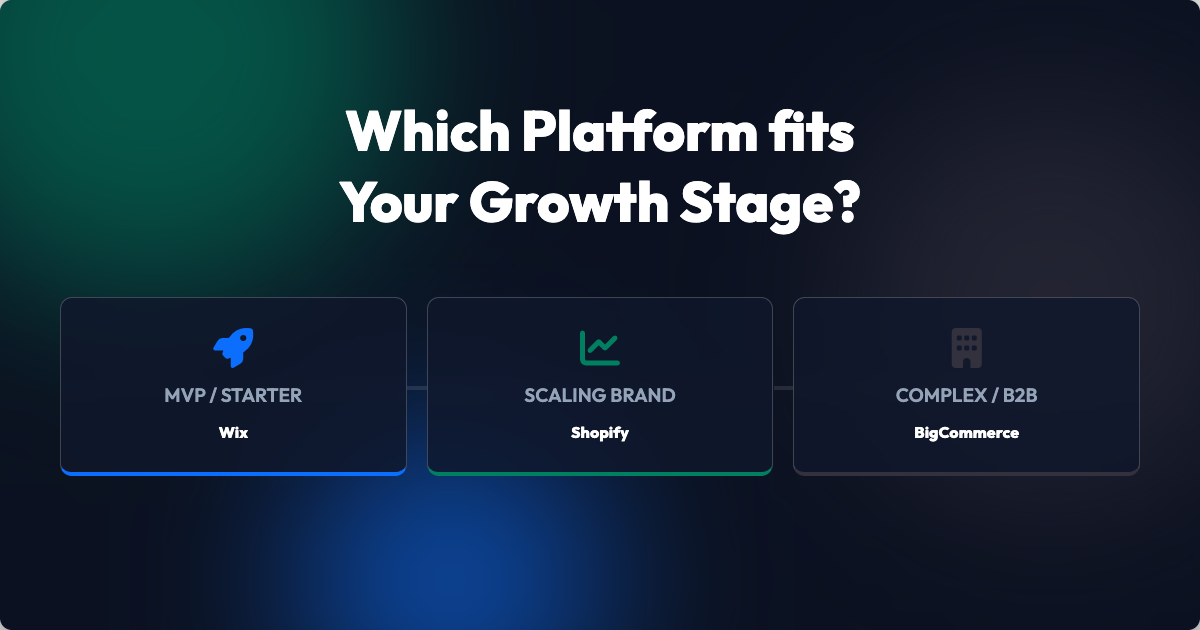
Shopify vs BigCommerce vs Wix: Which Platform Fits Your Growth Stage?
"Which ecommerce platform is the best?" is the wrong question. It's like asking "which car is the best?" without knowing if you need a city commuter, a family SUV, or a work truck.
The right question is: "Which platform fits MY current stage and intended growth path?"
I've built stores on all three platforms. I've helped merchants start on Wix and migrate to Shopify. I've seen BigCommerce stores that outperform Shopify stores. And I've watched merchants waste months on the wrong platform because they followed generic "X is better than Y" advice.
This guide is different. Instead of declaring a winner, I'll help you understand which platform makes sense for YOUR business stage—Starter MVP, Growing Brand, Scaling Operations, or Enterprise Multi-Store. By the end, you'll know exactly where you belong.
📋 Table of Contents
- 1. The Three Platforms at a Glance
- 2. Stage 1: Starter/MVP (0-$50K/year)
- 3. Stage 2: Growing Brand ($50K-$300K/year)
- 4. Stage 3: Scaling Operations ($300K-$1M/year)
- 5. Stage 4: Enterprise/Multi-Store ($1M+/year)
- 6. Feature Matrix by Need
- 7. SEO & Performance Comparison
- 8. App Ecosystem Reality
- 9. Real Pricing at Each Stage
- 10. Your Decision Tree
1. The Three Platforms at a Glance
Before we dive into stages, let's establish what each platform is fundamentally built for:
🟢 Shopify
Philosophy: "We handle everything so you can focus on selling."
Best For: DTC brands, dropshippers, omnichannel retail, those who want simplicity with scalability.
Market Position: The default choice. 4.4M+ stores. Massive app ecosystem. Aggressive feature development.
Pricing: $39-$399/month (Plus: $2,300+/month)
⚫ BigCommerce
Philosophy: "Enterprise features without enterprise complexity."
Best For: B2B, complex catalogs, multi-storefront needs, headless commerce enthusiasts.
Market Position: The challenger. ~60K stores. More built-in features, smaller app ecosystem. No transaction fees.
Pricing: $39-$399/month (Enterprise: custom)
🔵 Wix eCommerce
Philosophy: "Create a beautiful website that can also sell."
Best For: Small businesses, side hustles, service providers adding products, design-focused brands.
Market Position: Website-first, commerce-second. 500K+ ecommerce sites. Strongest visual builder. Limited for scale.
Pricing: $29-$59/month (Business plans)
2. Stage 1: Starter/MVP (0-$50K/year)
You're testing an idea. Maybe it's your first online store, a side project, or you're validating a product. Budget is tight, and you need to launch fast without overthinking.
🏆 Winner: Wix eCommerce
Why Wix at this stage:
- Lowest barrier to entry: $29/month all-in. No hidden costs at this scale.
- Best visual builder: Drag-and-drop that actually works. No code needed.
- Speed to launch: You can go from zero to selling in a weekend.
- All-in-one solution: Domain, hosting, email, and basic marketing built in.
- No commitment stress: Easy to migrate away if you outgrow it.
Realistic expectations: Wix will handle 0-100 orders/month without issue. Beyond that, you'll start feeling limitations. That's fine—it's a starting point, not a destination.
What About Shopify at Stage 1?
Shopify works at Starter stage, but you're paying for capability you don't need yet. The $39/month Shopify Basic plan is fine, but:
- You'll likely need 2-3 apps immediately (+$20-50/month)
- Shopify's themes are less visually flexible than Wix's builder
- The learning curve is slightly steeper
Consider Shopify at Stage 1 if: You're confident you'll grow quickly, you want to avoid a migration later, or you need features Wix can't handle (dropshipping integrations, certain payment methods).
What About BigCommerce at Stage 1?
Overkill. BigCommerce's strengths (B2B features, complex catalogs, multi-storefront) are irrelevant at this stage. You'd be paying for capability you won't use for years, if ever.
Stage 1 Decision Summary
- Default choice: Wix ($29/month)
- If you're certain about growth: Shopify Basic ($39/month)
- Skip: BigCommerce
3. Stage 2: Growing Brand ($50K-$300K/year)
Your MVP is validated. You're processing 50-500 orders/month. You're investing in marketing, maybe hiring help, and your store needs to perform. You're thinking about conversion rates, not just "does it work."
🏆 Winner: Shopify
Why Shopify at this stage:
- App ecosystem: 8,000+ apps for everything—reviews, upsells, email, subscriptions. You can solve any problem with an app.
- Theme quality: Professional themes that convert. Dawn, Impulse, Prestige—battle-tested designs.
- Reliability: 99.99% uptime. You can run ads without worrying about crashes.
- Shopify Payments: Integrated payments with fraud protection. Lower rates as you grow.
- Marketing integrations: Native Facebook/Instagram Shop, Google Shopping, TikTok. One-click setups.
- Community & Resources: Largest ecommerce community. Answers to every question exist.
Realistic expectations: Shopify shines at this stage. You'll pay $39-$105/month for the platform plus $100-300/month in apps. Worth every penny for the stability and ecosystem.
What About Wix at Stage 2?
This is where Wix starts struggling:
- Limited apps: The Wix App Market has fewer options, especially for advanced ecommerce needs.
- Performance ceilings: Wix sites can slow down with complex catalogs.
- Checkout limitations: Less flexibility than Shopify's checkout.
- SEO constraints: While improved, still not as robust as Shopify for large catalogs.
Stay on Wix if: You're doing mostly service + some products, or your product catalog is small (<50 SKUs) and simple.
What About BigCommerce at Stage 2?
BigCommerce is a viable alternative if you have specific needs:
- No transaction fees: BigCommerce doesn't charge extra for third-party payment gateways. If you use PayPal or a regional processor, this saves 0.5-2%.
- More built-in features: Real-time shipping quotes, faceted search, and customer groups are included. Shopify charges apps for these.
- B2B foundation: If you're selling both DTC and wholesale, BigCommerce handles this better natively.
Consider BigCommerce at Stage 2 if: You use non-Shopify payment gateways, you need B2B pricing, or you have a complex product catalog with many variants.
4. Stage 3: Scaling Operations ($300K-$1M/year)
You're no longer a "small business." You have staff, you're optimizing operations, margins matter more than ever. You need a platform that won't hold you back as you scale ads, expand channels, and increase SKUs.
🏆 Winner: Shopify (Advanced or approaching Plus)
Why Shopify continues to win:
- Shopify Advanced ($399/month): Lowest credit card rates, advanced reporting, third-party calculated shipping.
- Shopify Markets: Built-in international commerce. Multi-currency, localized checkouts, duties/taxes—all integrated.
- Sales channel depth: POS, Amazon, eBay, social commerce—all managed from one dashboard.
- Shopify Flow: Automation for inventory, marketing, fraud prevention. Reduces manual work.
- Partner ecosystem: Every SaaS tool integrates with Shopify first. Klaviyo, Gorgias, ShipBob—they optimize for Shopify.
BigCommerce's Strong Play at Stage 3
This is where BigCommerce makes its best case:
- Zero transaction fees: At $500K revenue, Shopify's 0.5% transaction fee (if not using Shopify Payments) = $2,500/year. BigCommerce charges $0.
- Headless commerce: BigCommerce's headless capabilities are arguably better than Shopify's (outside of Hydrogen).
- Multi-storefront: Run multiple storefronts from one backend. Shopify requires separate stores (or Plus).
- B2B+DTC: Customer groups, quote management, company accounts—all native.
Choose BigCommerce at Stage 3 if: B2B is significant (>30% of revenue), you need multi-storefront, or you're building a headless frontend.
Wix at Stage 3?
Migrate. Wix doesn't serve this stage. You'll hit performance walls, feature walls, and integration walls. If you're still on Wix at $300K+, you're leaving money on the table.
5. Stage 4: Enterprise/Multi-Store ($1M+/year)
You're a real business now. Custom integrations, ERP connections, dedicated support, and advanced automation. The platform needs to be as sophisticated as your operations.
Shopify Plus ($2,300+/month)
- Checkout customization: Full control over checkout with Checkout Extensibility (Scripts, UI Extensions).
- Automation: Shopify Flow for advanced workflows, LaunchPad for flash sales.
- Multi-store: Up to 10 expansion stores included (each new market).
- B2B on Shopify: Company profiles, net terms, quantity pricing—in one store.
- Dedicated support: Merchant Success Manager, priority support.
- Ecosystem: Every enterprise tool (NetSuite, SAP, Salesforce) has Shopify Plus connectors.
Best for: DTC brands going international, omnichannel retail, high-volume stores.
BigCommerce Enterprise (Custom Pricing)
- Headless-first: Superior API for custom frontends (Next.js, Gatsby, etc.).
- Multi-storefront native: Multiple storefronts, languages, currencies from one catalog.
- B2B excellence: The most robust native B2B features of any SaaS platform.
- No GMV limits: Unlike Shopify (which has sales-based plan thresholds), BigCommerce doesn't force upgrades based on revenue.
- Open integrations: More flexibility for custom ERP/PIM integrations.
Best for: B2B-heavy businesses, headless commerce projects, complex multi-store operations.
The Enterprise Reality
At $1M+, both platforms are capable. The decision often comes down to:
- DTC-focused? Shopify Plus. The ecosystem is unmatched for consumer brands.
- B2B-heavy or hybrid? BigCommerce Enterprise. Native B2B is genuinely better.
- Headless/custom frontend? Either works, but BigCommerce has slight API advantages.
- Omnichannel retail? Shopify Plus. POS integration is superior.
6. Feature Matrix by Need
Instead of "which has more features," let's look at features that actually matter:
| Feature/Need | Shopify | BigCommerce | Wix |
|---|---|---|---|
| Best for DTC Brands | ✓✓✓ | ✓✓ | ✓ |
| Best for B2B | ✓✓ | ✓✓✓ | ✗ |
| Subscriptions (Native) | ✓ (App) | ✓ (App) | ✓ |
| Multi-Currency | ✓✓✓ | ✓✓ | ✓ |
| POS/Retail | ✓✓✓ | ✗ | ✓ |
| Dropshipping Apps | ✓✓✓ | ✓ | ✓ |
| Real-Time Shipping Rates | ✓ (Advanced+) | ✓✓✓ | ✗ |
| Faceted Search | ✓ (Apps) | ✓✓✓ | ✗ |
| Multi-Storefront | ✓ (Plus) | ✓✓✓ | ✗ |
| Headless Commerce | ✓✓ | ✓✓✓ | ✗ |
| Visual Site Builder | ✓ | ✗ | ✓✓✓ |
| App Ecosystem Size | ✓✓✓ | ✓ | ✓✓ |
7. SEO & Performance Comparison
SEO matters, especially for content-led brands. Here's the honest comparison:
Shopify SEO
- URL structure: Forced /collections/ and /products/ prefixes. Not ideal but not a dealbreaker.
- Blogging: Basic. Works for simple content. Limited for media-heavy sites.
- Speed: Generally excellent. Shopify's CDN and infrastructure are fast.
- Schema markup: Basic product schema. Need apps for advanced structured data.
- Verdict: Good enough for 95% of stores. Only problematic for content-heavy businesses.
BigCommerce SEO
- URL structure: Fully customizable. You control every URL.
- Blogging: Better than Shopify, still not WordPress-level.
- Speed: Variable. Depends more on your implementation and apps.
- Schema markup: More built-in schema options.
- Verdict: Slight edge for technical SEO, but requires more effort to optimize.
Wix SEO
- URL structure: Fully customizable.
- Blogging: Excellent for a commerce platform.
- Speed: Variable. Can slow down with heavy pages.
- Schema markup: Basic, improving.
- Verdict: Better than its reputation, but large catalogs can face crawl/index challenges.
SEO Bottom Line
For pure ecommerce SEO (product pages, collections), all three are fine. The differences are minimal compared to content quality and backlink strength.
For content marketing + ecommerce, consider WordPress + WooCommerce or using a headless CMS with Shopify/BigCommerce.
8. App Ecosystem Reality
The app ecosystem is one of Shopify's biggest advantages—but it's not entirely positive:
Shopify: Quantity with Caveats
- 8,000+ apps: Solution for everything. Reviews, upsells, subscriptions, fulfillment, marketing.
- The catch: Shopify depends on apps. Features that should be built-in (product filters, real-time shipping) require paid apps.
- Cost impact: Typical store uses 6-12 apps. At $10-50/month each, that's $100-400/month in app fees.
- Performance risk: Each app adds JavaScript. 15 apps = slow site.
BigCommerce: Built-In Focus
- Fewer apps (~1,500): Smaller marketplace, but more built-in features.
- Included features: Faceted search, customer groups, real-time shipping, unlimited variants—all native.
- The catch: When you DO need an app, options are limited. Some categories have 2-3 options vs Shopify's 50+.
Wix: Curated Selection
- 500+ ecommerce apps: Covers basics. Fewer advanced options.
- Advantage: Apps are more tightly integrated. Less conflict risk.
- The catch: For advanced needs (enterprise email, custom fulfillment), you may not find a solution.
9. Real Pricing at Each Stage
Let's get concrete about what you'll actually pay at each growth stage:
Stage 1: MVP ($0-$50K revenue)
| Platform | Platform Fee | Apps/Add-ons | Processing (@ 2.9%) | Total Annual |
|---|---|---|---|---|
| Wix Business | $348 | $0-100 | $1,450 | $1,798-$1,898 |
| Shopify Basic | $468 | $300-600 | $1,450 | $2,218-$2,518 |
| BigCommerce Standard | $468 | $100-200 | $1,450 | $2,018-$2,118 |
Stage 2: Growing ($50K-$300K revenue)
| Platform | Platform Fee | Apps | Processing (@ 2.6% avg) | Total Annual |
|---|---|---|---|---|
| Shopify (Basic) | $468 | $1,800 | $7,800 | $10,068 |
| BigCommerce Plus | $948 | $600 | $7,800 | $9,348 |
Stage 3: Scaling ($300K-$1M revenue)
| Platform | Platform Fee | Apps | Processing | Total Annual |
|---|---|---|---|---|
| Shopify Advanced | $4,788 | $3,600 | $18,200 | $26,588 |
| BigCommerce Pro | $3,588 | $1,200 | $20,300 | $25,088 |
Note: At Stage 3, the platforms are similarly priced. BigCommerce saves on apps but has slightly higher processing if not using their preferred gateways.
10. Your Decision Tree
Here's the simplified decision flow:
Quick Decision Guide
1. What's your current annual revenue?
- $0-$50K → Start with Wix (or Shopify if confident about growth)
- $50K-$300K → Shopify (or BigCommerce for B2B)
- $300K-$1M → Shopify Advanced (or BigCommerce Pro)
- $1M+ → Shopify Plus (or BigCommerce Enterprise for B2B)
2. Is B2B significant (>30% of business)?
- Yes → Consider BigCommerce
- No → Shopify
3. Do you need retail POS?
- Yes → Shopify (only real option)
4. Is content a major part of your strategy?
- Yes + simple products → Wix
- Yes + growing store → Consider headless (BigCommerce + CMS)
5. Do you use non-standard payment gateways?
- Yes → BigCommerce (no transaction fees)
Migration Reality Check
Worried about choosing wrong? Migration is always an option:
- Wix → Shopify: Relatively easy. Products, customers, orders export/import smoothly.
- BigCommerce ↔ Shopify: Both directions are well-supported. Plenty of migration apps and services.
- Any → Any: Budget 4-8 weeks and $2,000-$10,000 for a professional migration.
Don't let migration fear paralyze you. Choose based on TODAY's needs. You can always migrate if your needs change.
Need Help Choosing?
Still unsure which platform fits your situation? I offer free 30-minute platform consultations where we:
- Analyze your current business stage and growth trajectory
- Discuss your specific feature requirements
- Calculate real costs for your scenario
- Provide a clear recommendation
Ready to Choose Your Platform?
Whether you're starting fresh, scaling up, or considering a migration, I can help you make the right call.