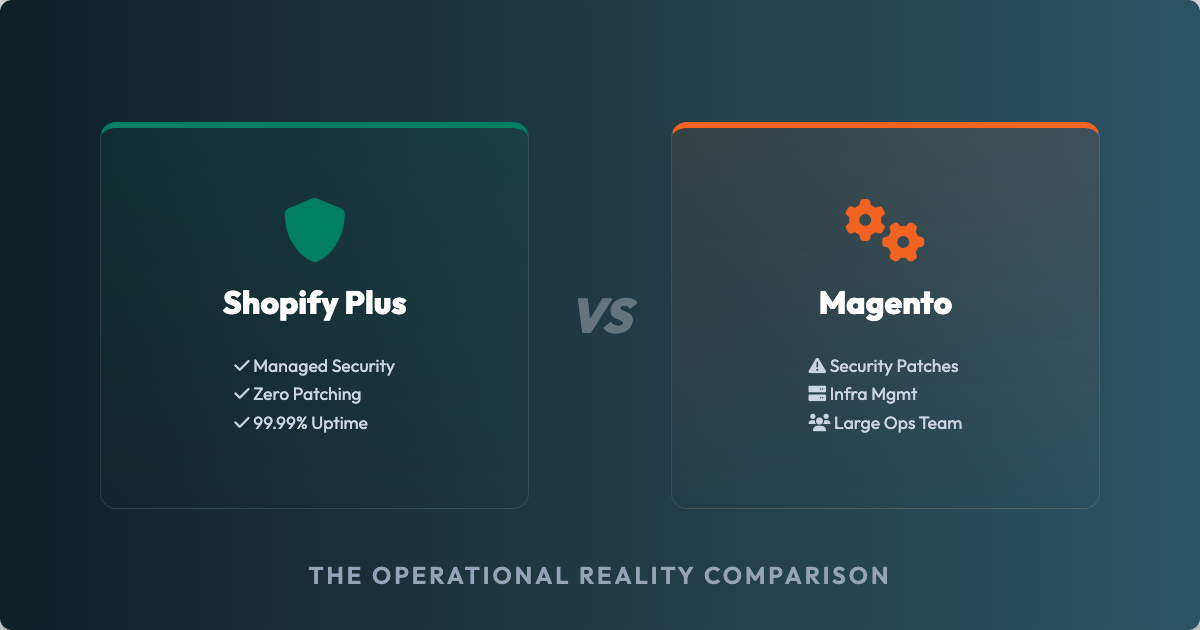
Shopify vs Magento (Adobe Commerce): The "Ops Reality" Comparison
Most Shopify vs Magento comparisons focus on features. They compare product variant limits, checkout options, and catalog capabilities. Those comparisons miss what actually matters for mid-market brands: the operational reality of running each platform.
I've worked with companies running both platforms. I've seen the 3 AM Slack messages when a Magento security patch breaks the checkout. I've watched teams spend 40 hours/month just keeping Magento updated. And I've helped brands migrate away when they realized the "flexibility" of Magento was costing them more than it saved.
This guide isn't about which platform has more features. It's about the real cost of operations: security patch cadence, maintenance burden, team requirements, vulnerability response, and what happens when things go wrong.
If you're running Magento and wondering whether Shopify Plus is worth the migration—or if you're choosing between them for a new project—this is the analysis you need.
📋 Table of Contents
- 1. What Magento Is Actually Good At
- 2. The True "Run Cost" of Magento
- 3. Security Patch Reality: The Operational Nightmare
- 4. Team Requirements: Hidden Staffing Costs
- 5. When a Critical CVE Hits: Real Scenario
- 6. The Shopify Plus Alternative
- 7. 5-Year TCO Comparison
- 8. The Migration Path: Feasibility & Timeline
- 9. Decision Framework: Who Should Stay vs Go
1. What Magento Is Actually Good At (Being Honest)
Before we dive into the operational challenges, let's be fair: Magento exists for reasons. It's not the wrong choice for everyone. Here's what Magento does genuinely well:
Complex Catalog Structures
Magento handles massive, complex product catalogs better than any other platform. If you have:
- 100,000+ SKUs with complex attributes
- Configurable products with dozens of options
- Multiple websites with shared catalogs but different pricing
- Intricate category hierarchies with inheritance
Magento was built for this. Shopify can handle large catalogs now, but Magento's data model is still more sophisticated.
Custom Business Logic
Magento is open-source and infinitely customizable. Need:
- Custom checkout flows that don't follow any standard pattern
- Complex tiered pricing with negotiated customer-specific rates
- Integration with legacy ERP systems using proprietary protocols
- Multi-warehouse inventory with custom allocation rules
Magento lets you do literally anything. There are no platform-imposed limits. Every piece of code is modifiable.
B2B Commerce at Scale
Adobe Commerce's B2B features are mature:
- Company accounts with buyer hierarchies
- Request for Quote (RFQ) workflows
- Purchase orders and approval flows
- Shared catalogs with customer-group pricing
- Requisition lists and quick order forms
Shopify Plus B2B is improving rapidly but Magento's B2B has 5+ years of maturity advantage.
Multi-Store at Enterprise Scale
One Magento installation can power:
- Multiple websites (different domains)
- Multiple stores per website (different categories/languages)
- Multiple store views per store (different currencies/languages)
A single Magento deployment running 50 different storefronts is common in enterprise. Shopify needs separate stores or Shopify Plus expansion stores.
Key Point
If you're NOT operating at this complexity level—massive catalogs, heavily customized logic, large B2B operations—you're paying for capability you don't need. And paying heavily in operational overhead.
2. The True "Run Cost" of Magento
License cost is just the beginning. Here's what actually goes into running Magento:
Infrastructure Costs
Magento Cloud Hosting Requirements
Magento is resource-intensive. Minimum production requirements:
- Web servers: 2+ load-balanced instances (4 vCPU, 8GB RAM each)
- Database: MySQL/MariaDB cluster (8+ vCPU, 32GB RAM)
- Elasticsearch/OpenSearch: Required for catalog search (4 vCPU, 8GB RAM)
- Redis: For cache and sessions (2 instances)
- Varnish: Full-page caching layer
- RabbitMQ: For async operations (if using)
Typical monthly hosting: $1,500-$5,000/month for a mid-sized store. Enterprise: $5,000-$15,000/month.
Update & Upgrade Cycle
Magento requires constant attention:
| Update Type | Frequency | Typical Time Required | Risk Level |
|---|---|---|---|
| Security Patches | Every 4-8 weeks | 4-16 hours per patch | High (break risk) |
| Minor Updates (2.4.x) | Quarterly | 20-40 hours | Medium-High |
| Major Upgrades (2.x to 2.y) | Annually | 80-200+ hours | Very High |
| Extension Updates | Monthly | 2-8 hours per extension | Medium |
| PHP Version Upgrades | Every 1-2 years | 40-80+ hours | High |
Conservative estimate: 15-30 hours/month just keeping Magento current. That's a significant portion of a developer's time.
Quality Assurance Requirements
Every Magento update requires testing:
- Staging environment: You need a production-mirror staging server ($500-$1,500/month)
- Regression testing: After each update, test all critical paths
- Extension compatibility: Updates can break extensions; each needs verification
- Visual regression: Frontend changes can break themes
Professional QA for Magento updates: 10-20 hours/month minimum.
3. Security Patch Reality: The Operational Nightmare
This is where Magento's operational burden becomes critical. Let me be direct: Magento's security patch cadence is one of the most demanding in ecommerce.
The Patch Cycle
Adobe releases security patches regularly. In 2025 alone, there were multiple critical security updates requiring immediate action. Each patch cycle looks like this:
Real-world timeline: 2-3 weeks from patch release to fully deployed and stable. During this time, you're potentially exposed to known vulnerabilities.
⚠️ Recent Critical Vulnerabilities
Adobe Commerce has had several critical security patches in recent years requiring immediate attention:
- CosmicSting (CVE-2024-34102): Critical XML injection vulnerability. CVSS 9.8.
- Multiple RCE vulnerabilities: Remote code execution bugs discovered regularly
- APSB patches: Adobe's patch schedule means constant updates
Each of these required immediate (within 24-48 hours) attention from development teams.
The Cascade Effect
Security patches create operational cascades:
- Patch breaks extension: Extension vendor takes 1-4 weeks to release compatible version
- Patch breaks customization: Your team has to fix custom code conflicts
- Multiple patches queue: While waiting for fixes, new patches release
- Version drift: You fall behind, making future updates harder
- Technical debt: Workarounds accumulate
I've seen stores running 6+ months behind on patches because each update cascade takes so long to resolve. This is a security disaster waiting to happen.
4. Team Requirements: Hidden Staffing Costs
Magento requires specialized skills. This is often the largest hidden cost.
Magento Team Requirements
Minimum viable team:
- Magento Developer (1-2): $80K-$150K/year each
- DevOps/SysAdmin (0.5-1): $70K-$120K/year
- QA Specialist (0.5): $50K-$80K/year
Annual minimum: $150K-$350K in direct staffing
Or equivalent agency retainer: $10K-$25K/month
Shopify Plus Team Requirements
Minimum viable team:
- Shopify Developer (0.5-1): $60K-$100K/year
- DevOps: $0 (Shopify manages)
- QA: Minimal (platform handles stability)
Annual minimum: $30K-$100K in staffing
Or equivalent: $3K-$8K/month agency support
The Availability Problem
Good Magento developers are:
- Scarce: The talent pool is shrinking as developers move to other platforms
- Expensive: Premium salaries due to specialized knowledge
- In demand: High turnover risk—they get recruited constantly
Shopify developer talent:
- Growing: Massive community, educational resources, bootcamps
- More available: Lower barrier to entry means more developers
- Lower rates: Competition keeps costs reasonable
5. When a Critical CVE Hits: Real Scenario
Let me walk you through what happens when a critical vulnerability is announced. This is based on real incidents I've helped clients navigate:
Scenario: Critical RCE Vulnerability Announced
9:00 AM Tuesday: Adobe releases security advisory. CVSS 9.8 (Critical). Remote code execution possible without authentication.
The Magento Response
Hour 1-2: Your security team (if you have one) assesses the vulnerability. You realize your site is vulnerable. Attackers are already scanning the internet.
Hour 2-4: Download patch. Review patch notes. Discover it requires PHP 8.1 but you're on PHP 7.4. The upgrade path just got complicated.
Hour 4-8: Apply patch to staging. It breaks three extensions (reviews, shipping calculator, custom checkout). Contact extension vendors for updates.
Day 2-3: One vendor responds with updated extension. Two vendors say "we're working on it." Your checkout is broken on staging—can't test properly.
Day 3-7: You implement workarounds. Disable one extension temporarily. Apply custom fixes to another. Test critical paths.
Day 7-10: Deploy to production during 2 AM maintenance window. Something goes wrong. Rollback. Debug. Redeploy at 3 AM. Success—finally.
Total impact:
- ~40 hours of developer/DevOps time
- 7+ days of exposure to known vulnerability
- Lost sleep, weekend work, high stress
- ~$5,000-$15,000 in emergency labor costs
The Shopify Response
Shopify's infrastructure is not your responsibility.
If a security vulnerability is discovered:
- Shopify's security team patches it
- All stores are protected simultaneously
- You don't even know it happened (unless you read their security blog)
Your involvement: Zero hours. Zero stress. Zero cost.
6. The Shopify Plus Alternative
Let's review what Shopify Plus offers and whether it can replace Magento for your use case:
Shopify Plus Capabilities (2026)
| Feature | Shopify Plus | Adobe Commerce |
|---|---|---|
| Checkout Customization | ✓ Checkout Extensibility (UI, Functions) | ✓ Full control |
| B2B Features | ✓ Company profiles, net terms, catalogs | ✓✓ More mature/complete |
| Multi-Storefront | ✓ Up to 10 expansion stores | ✓✓ Unlimited, more flexible |
| Automation (Flows) | ✓ Shopify Flow (powerful) | ✓ Custom code required |
| API/Headless | ✓ Storefront API + Hydrogen | ✓✓ GraphQL + REST |
| Product Limits | Unlimited products, 2K variants/product | Unlimited everything |
| Security Maintenance | ✓✓✓ Shopify handles | ✗ Your responsibility |
| Uptime SLA | 99.99% guaranteed | Depends on your hosting |
Where Shopify Plus Still Falls Short
To be fair, there are scenarios where Shopify Plus isn't sufficient:
- Extremely complex catalogs: 500K+ SKUs with complex attributes
- Heavily customized checkout: If you need checkout logic Checkout Extensibility can't handle
- Legacy integrations: Old ERP/WMS systems with only custom connectors
- Multi-tenant B2B: Complex company hierarchies with unique workflows
However: For 80%+ of current Magento stores, Shopify Plus now covers requirements adequately.
7. 5-Year Total Cost of Ownership Comparison
Let's calculate real 5-year TCO for a mid-market brand ($3M-$10M annual revenue):
| Cost Category | Shopify Plus (5-Year) | Adobe Commerce (5-Year) |
|---|---|---|
| License/Subscription | $138,000 | $250,000+ |
| Hosting/Infrastructure | $0 (included) | $180,000 |
| Development Team/Agency | $300,000 | $750,000 |
| Security/Maintenance | $0 | $150,000 |
| Apps/Extensions | $90,000 | $75,000 |
| Upgrades/Migrations | $0 | $200,000 |
| Incident Response | $10,000 | $100,000 |
| 5-YEAR TOTAL | $538,000 | $1,705,000 |
8. The Migration Path: Feasibility & Timeline
If you're considering migrating from Magento to Shopify Plus, here's what to expect:
Migration Timeline (Realistic)
| Phase | Duration | Key Activities |
|---|---|---|
| Discovery & Planning | 2-4 weeks | Data audit, requirements mapping, app selection |
| Data Migration | 2-3 weeks | Products, customers, orders, categories |
| Theme Development | 6-10 weeks | Design, build, custom sections |
| Integrations | 2-4 weeks | ERP, CRM, email, fulfillment |
| Testing & QA | 2-3 weeks | UAT, performance, SEO verification |
| Launch & Stabilization | 1-2 weeks | DNS cutover, monitoring, fixes |
| TOTAL | 15-26 weeks | 4-6 months typical |
Migration Cost Ranges
- Simple store (< 1,000 SKUs, standard theme): $50,000-$100,000
- Mid-complexity (5,000+ SKUs, custom features): $100,000-$250,000
- Complex (50,000+ SKUs, B2B, integrations): $250,000-$500,000+
ROI Timeline
Based on the TCO comparison above, most migrations pay for themselves within 12-18 months through:
- Eliminated hosting costs
- Reduced development overhead
- Zero security maintenance
- Lower agency/staffing needs
9. Decision Framework: Who Should Stay vs Go
Stay on Magento If:
- ✓ You have 100,000+ SKUs with complex data requirements
- ✓ Your checkout is heavily customized beyond Checkout Extensibility capabilities
- ✓ You have dedicated Magento development staff you want to keep
- ✓ Your B2B workflows are extremely complex and proven
- ✓ You run 10+ storefronts from one installation
- ✓ You're on Adobe Commerce Cloud with a recent major upgrade (sunk cost)
Migrate to Shopify Plus If:
- ✓ Security patch cycles are consuming your team
- ✓ You're behind on Magento versions and facing forced upgrades
- ✓ Development costs are exceeding platform value
- ✓ You want to focus on business, not infrastructure
- ✓ DTC is your primary channel (B2B secondary)
- ✓ You need better POS/omnichannel
- ✓ Your Magento talent is leaving and hard to replace
Need a Replatform Feasibility Assessment?
I help mid-market brands evaluate the Magento → Shopify Plus migration path. In a free 45-minute consultation, I can:
- Audit your current Magento implementation
- Identify Shopify Plus feature gaps (if any)
- Estimate migration timeline and budget
- Calculate your potential TCO savings
- Provide an honest recommendation (including "don't migrate" if appropriate)
No obligation. Data-driven analysis for your specific situation.
Conclusion: It's About Operational Reality
Magento isn't a bad platform. It's an incredibly powerful platform that's right for specific use cases—massive catalogs, extreme customization, complex B2B.
But for most mid-market brands, the operational burden of Magento has become unjustifiable. Security patches every 6 weeks. $150K+/year in staffing just to maintain the platform. The constant fear of the next critical CVE.
Shopify Plus isn't as flexible. It has limits. But those limits come with benefits: zero ops burden, 99.99% uptime, and a chance to focus on your actual business instead of managing infrastructure.
The question isn't "which is better?" It's "what operational model can your business sustain?"
If you're tired of being in the ecommerce platform management business and want to get back to the commerce business, let's talk about your options.
Ready to Escape the Ops Burden?
Whether you want to migrate away from Magento or optimize your current setup, I can help you reduce operational overhead.